Configuration templates and drift

Keep Your Standard From Becoming a Suggestion

A configuration standard is useful only if you can apply it and check it. SYNOP•SYS connects reusable templates with deliberate application and scheduled drift detection.

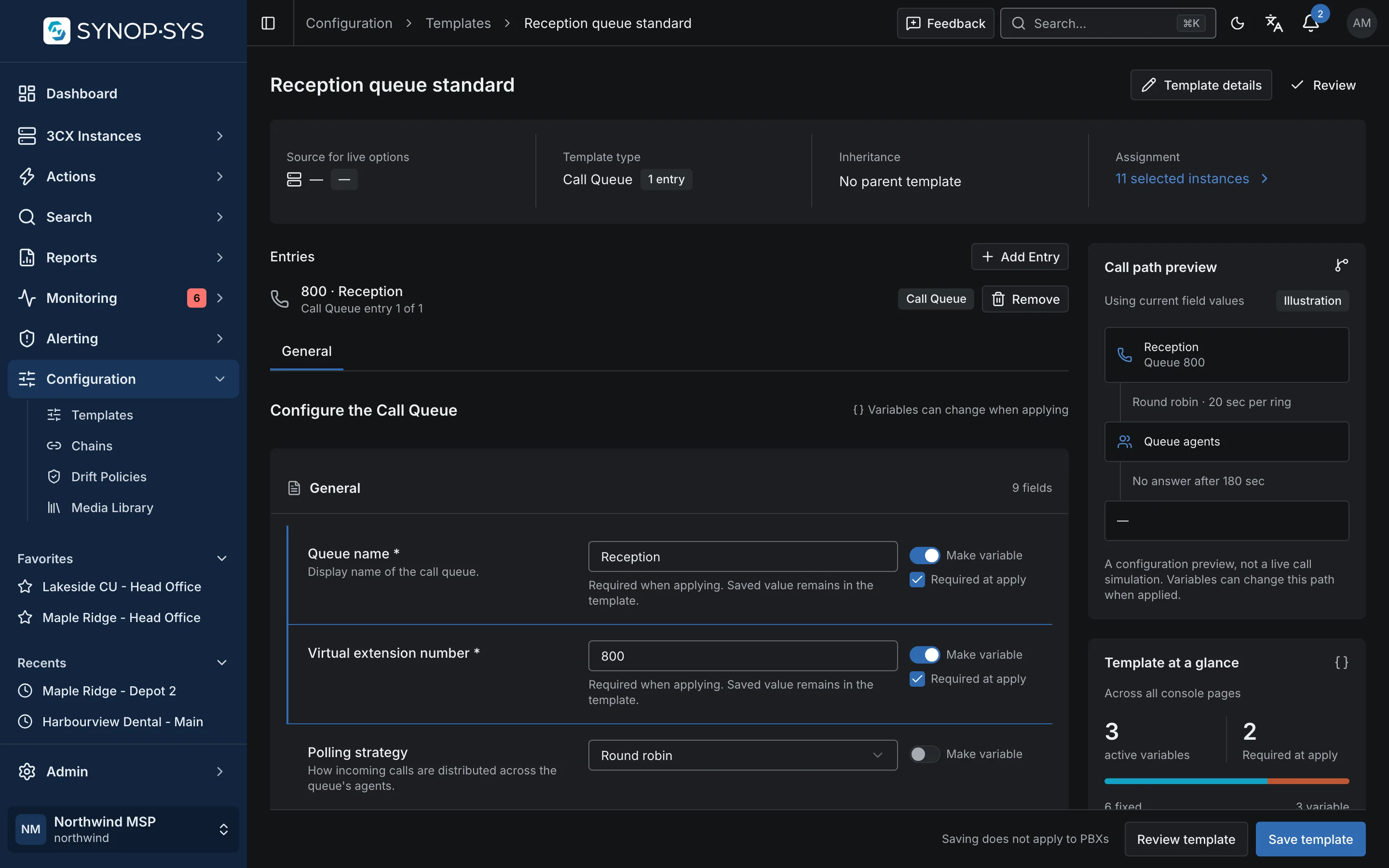
A queue template: managed fields with three variables for the values that change per site. A queue template: managed fields with three variables for the values that change per site.
A queue template: managed fields with three variables for the values that change per site.Open full imageOpen full image

Templates

Start With Configuration You Already Know

Capture supported configuration from a live PBX or create a template directly. Define the fields the template manages and use variables where the applied values need to change.

  • Templates cover the configuration schemas SYNOP•SYS marks templateable
  • Variables can be required, optional or secret (entered at apply time, never stored)
  • The editor shows which fields the template manages and which it leaves alone
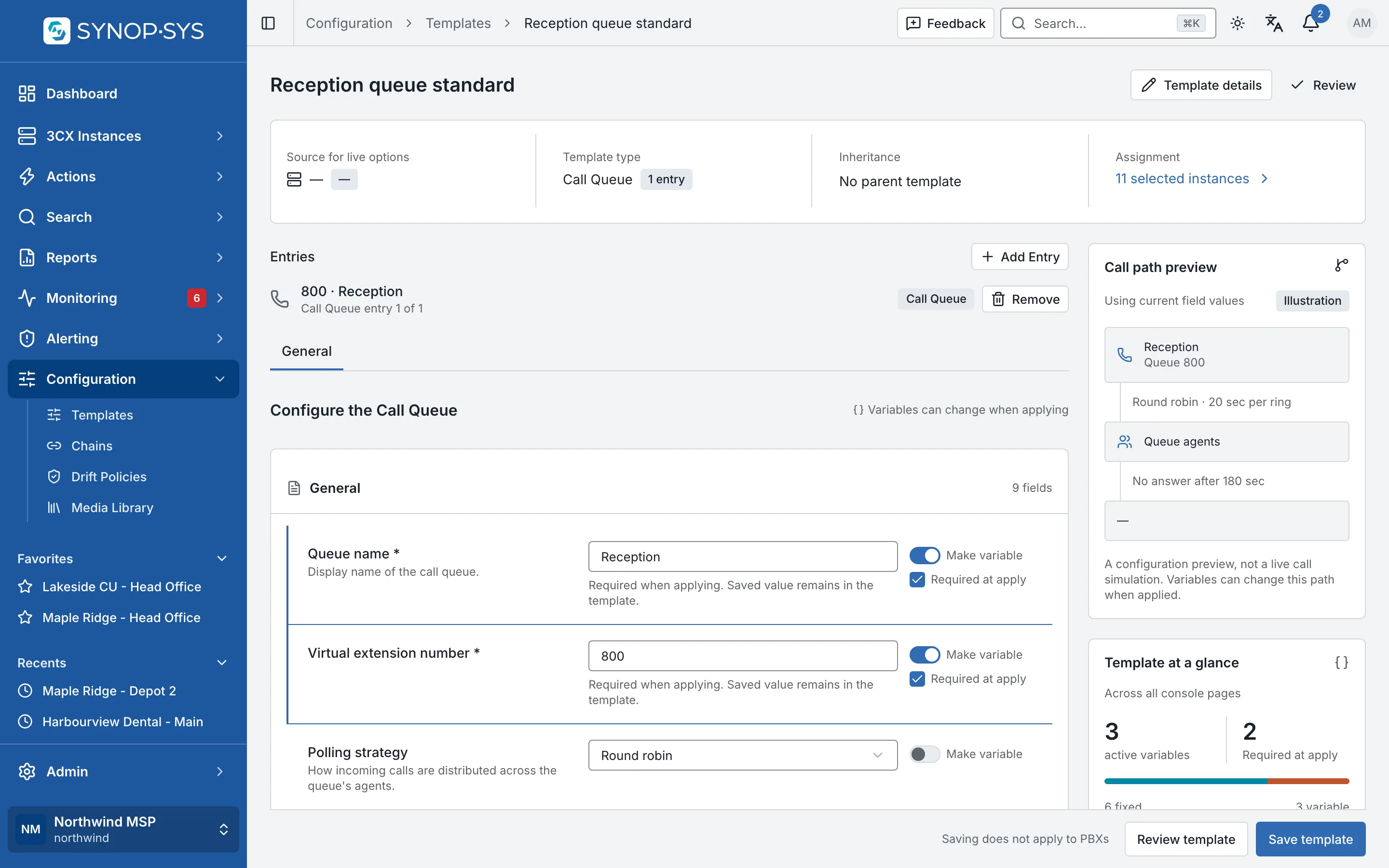
The template editor for Reception queue standard. The template editor for Reception queue standard.
The template editor for Reception queue standard.Open full imageOpen full image

Apply

Apply the Template to the Right Systems

Choose instances, groups, tags or an allowed fleet scope and supply the template values. Review the per-instance results, including failures and fields that could not be applied to a target.

  • The target expression is validated against what you may reach, not only what it resolves to today
  • Successful targets stay applied if another fails; there is no fleet-wide rollback
  • Every apply is recorded in the PBX write audit with its origin
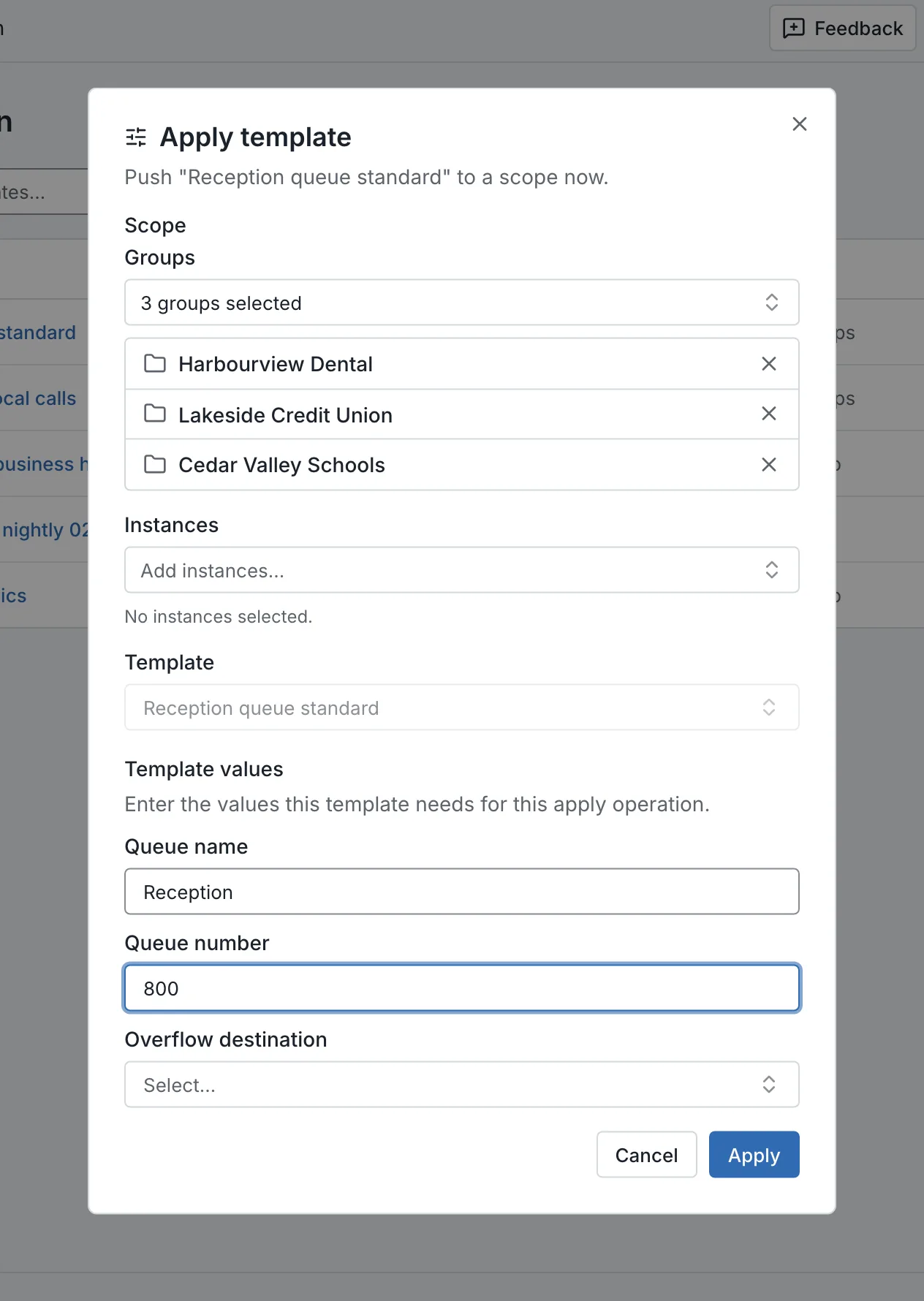
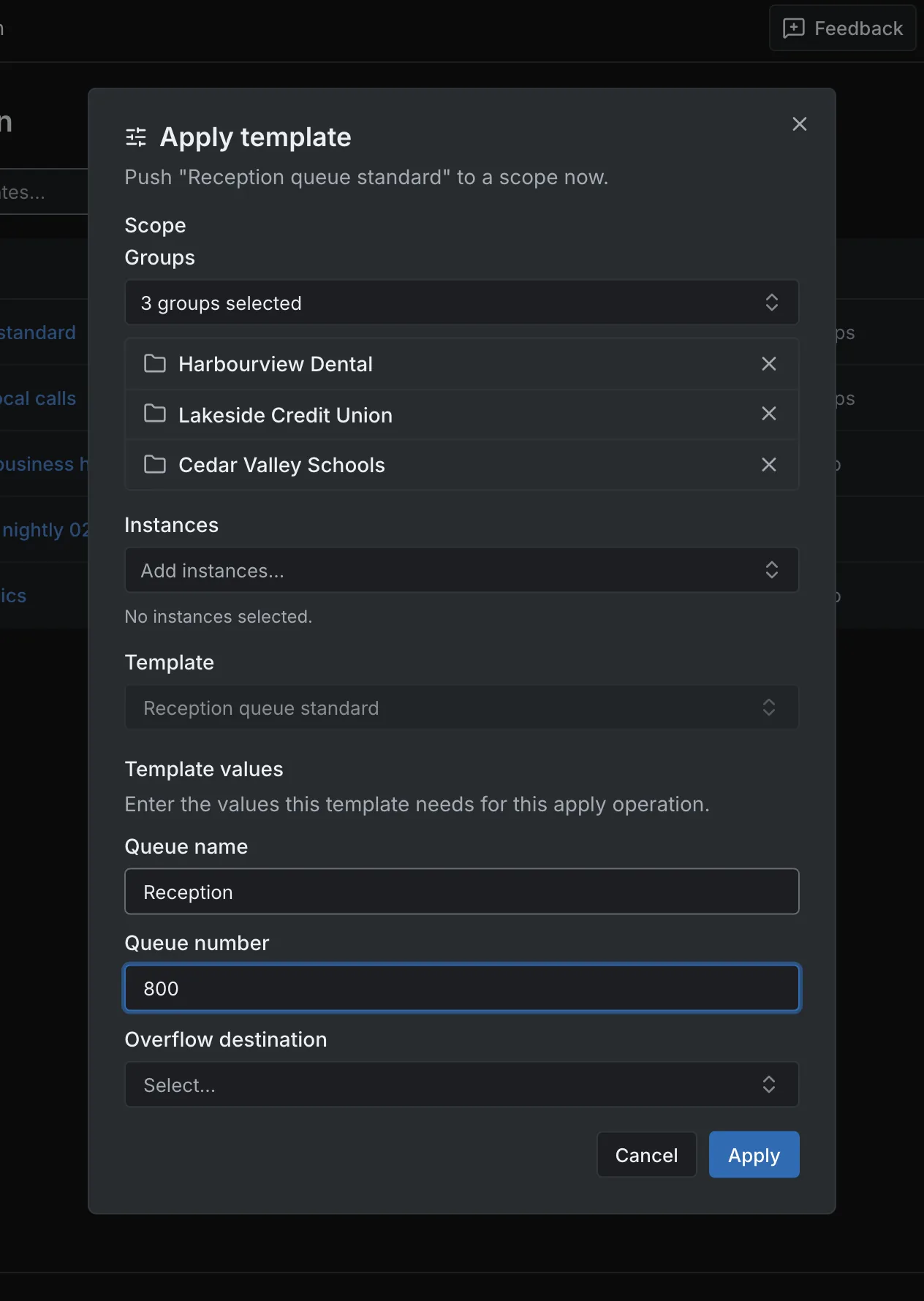
Apply dialog: scope, template and variable values, reviewed before anything runs. Apply dialog: scope, template and variable values, reviewed before anything runs.
Apply dialog: scope, template and variable values, reviewed before anything runs.Open full imageOpen full image

Chains

Connect Dependent Changes With Template Chains

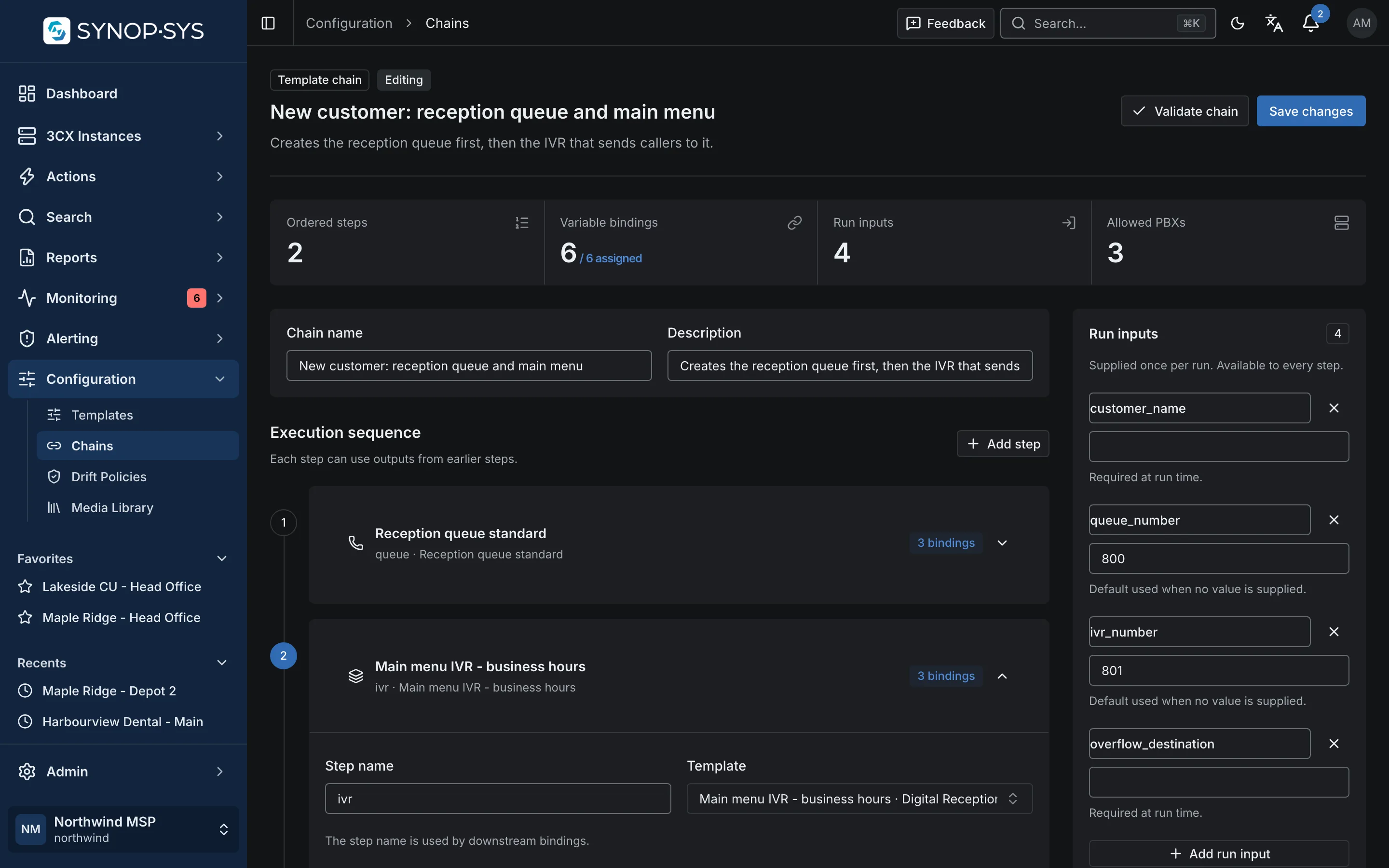
Put templates in execution order and connect later inputs to values produced by earlier resource steps. Run the chain through Apply Template Chain; each PBX keeps its own step outputs.

  • Run inputs supplied once per run, available to every step
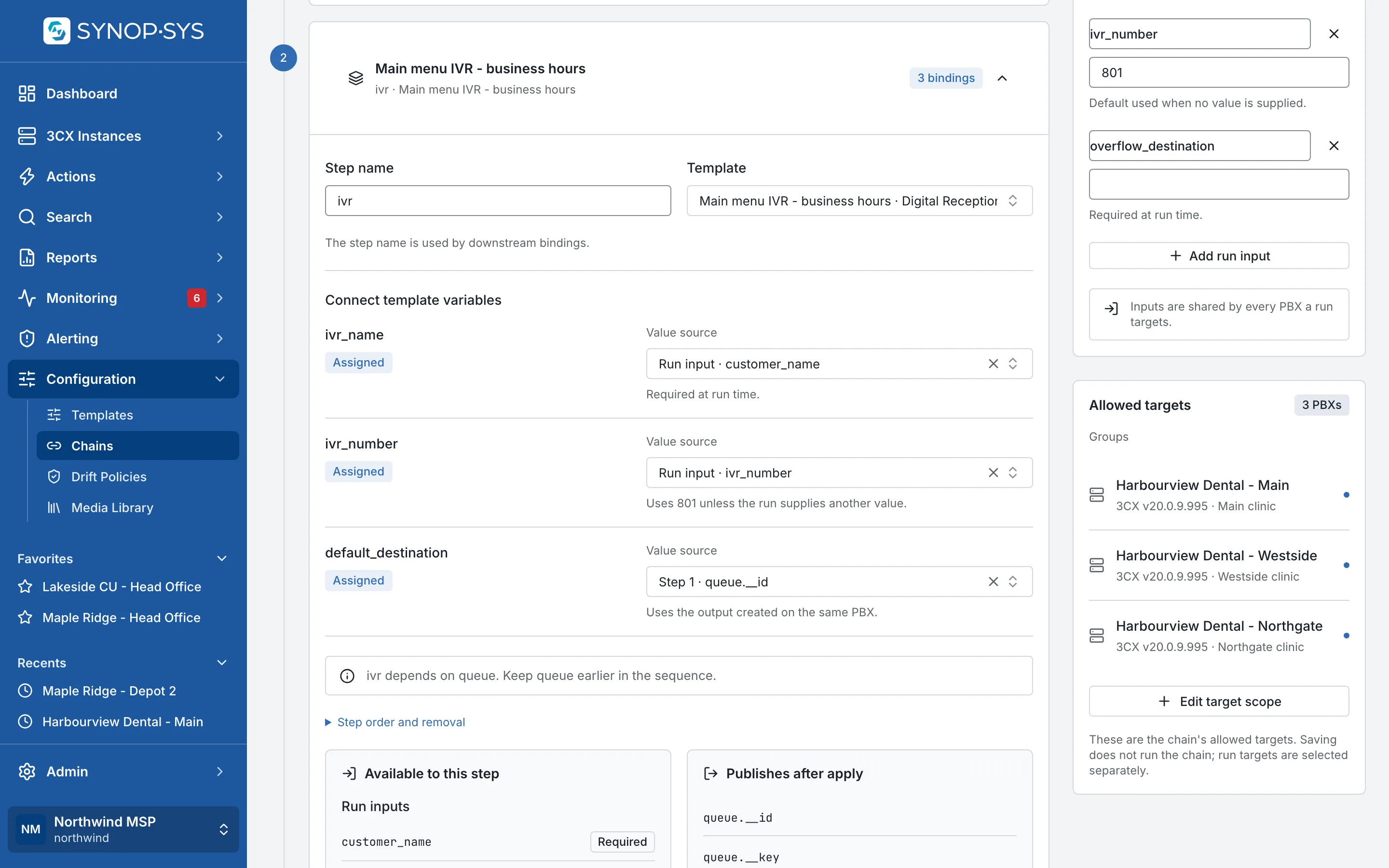
  • Bindings reference earlier outputs such as the created queue’s ID
  • A chain stops at the failing step for that instance
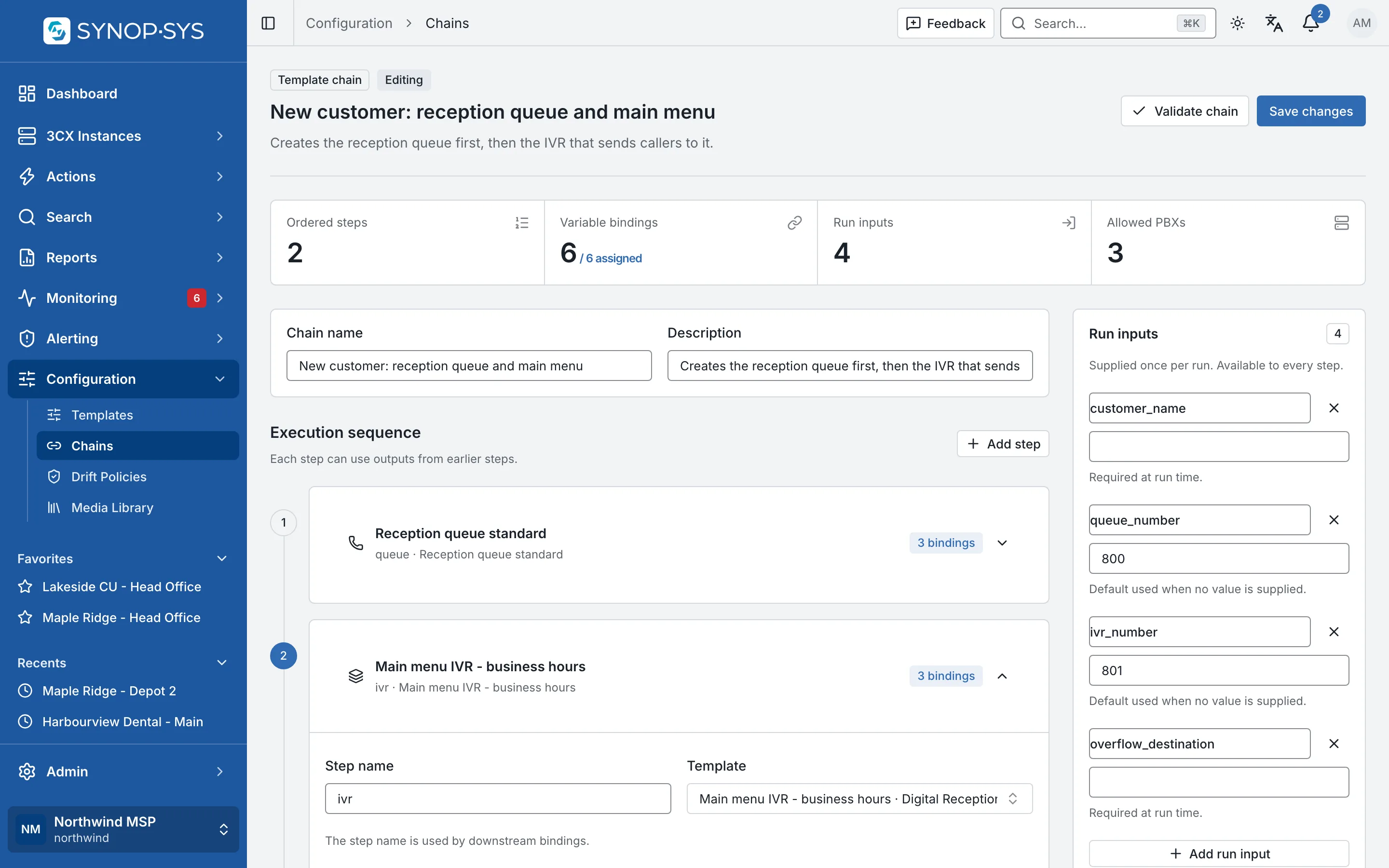
The chain: two ordered steps, four run inputs, three allowed PBXs. The chain: two ordered steps, four run inputs, three allowed PBXs.
The chain: two ordered steps, four run inputs, three allowed PBXs.Open full imageOpen full image
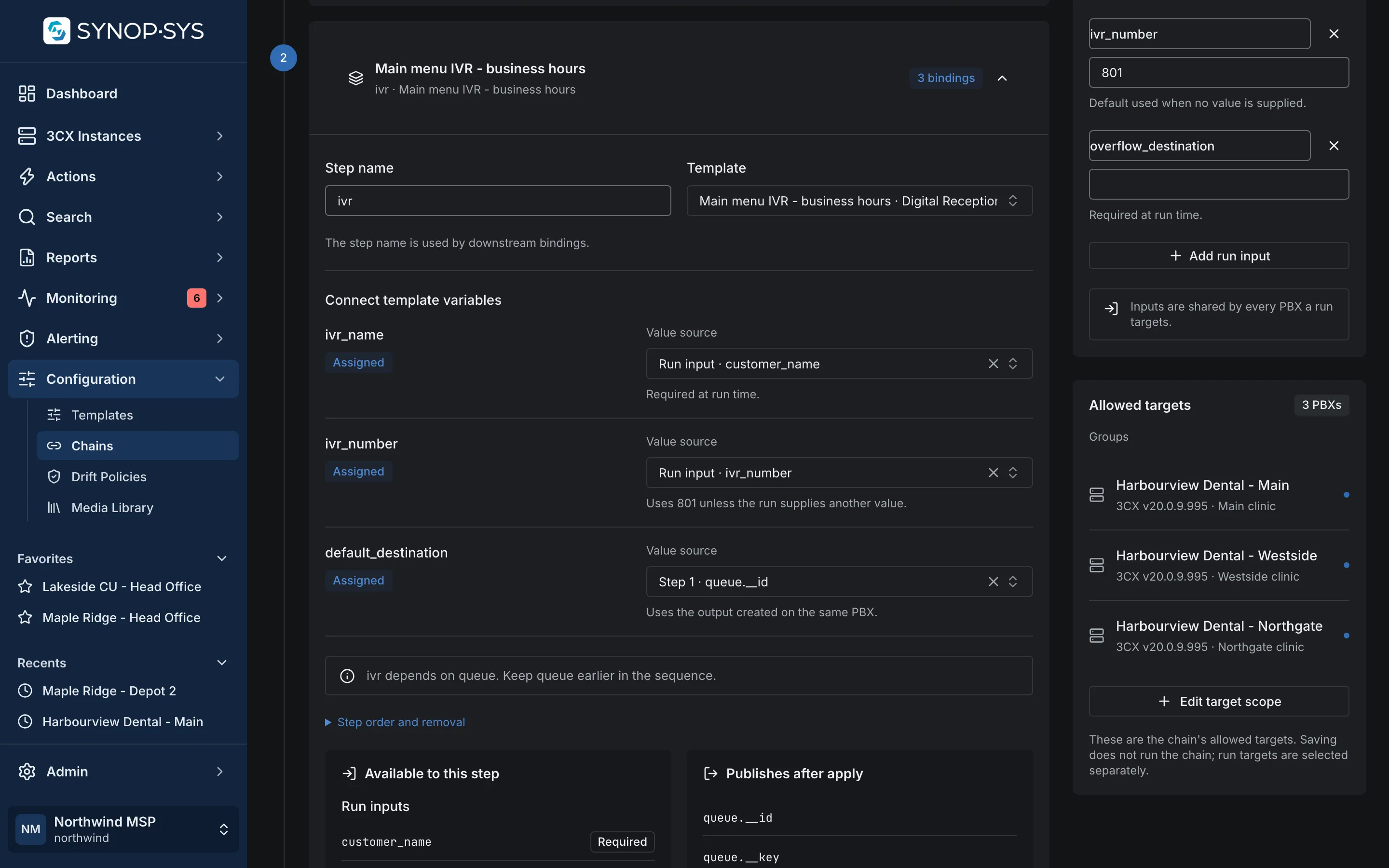
Step two binds default_destination to queue.__id, the output of step one. Step two binds default_destination to queue.__id, the output of step one.
Step two binds default_destination to queue.__id, the output of step one.Open full imageOpen full image

See the Difference, Not Just a Warning

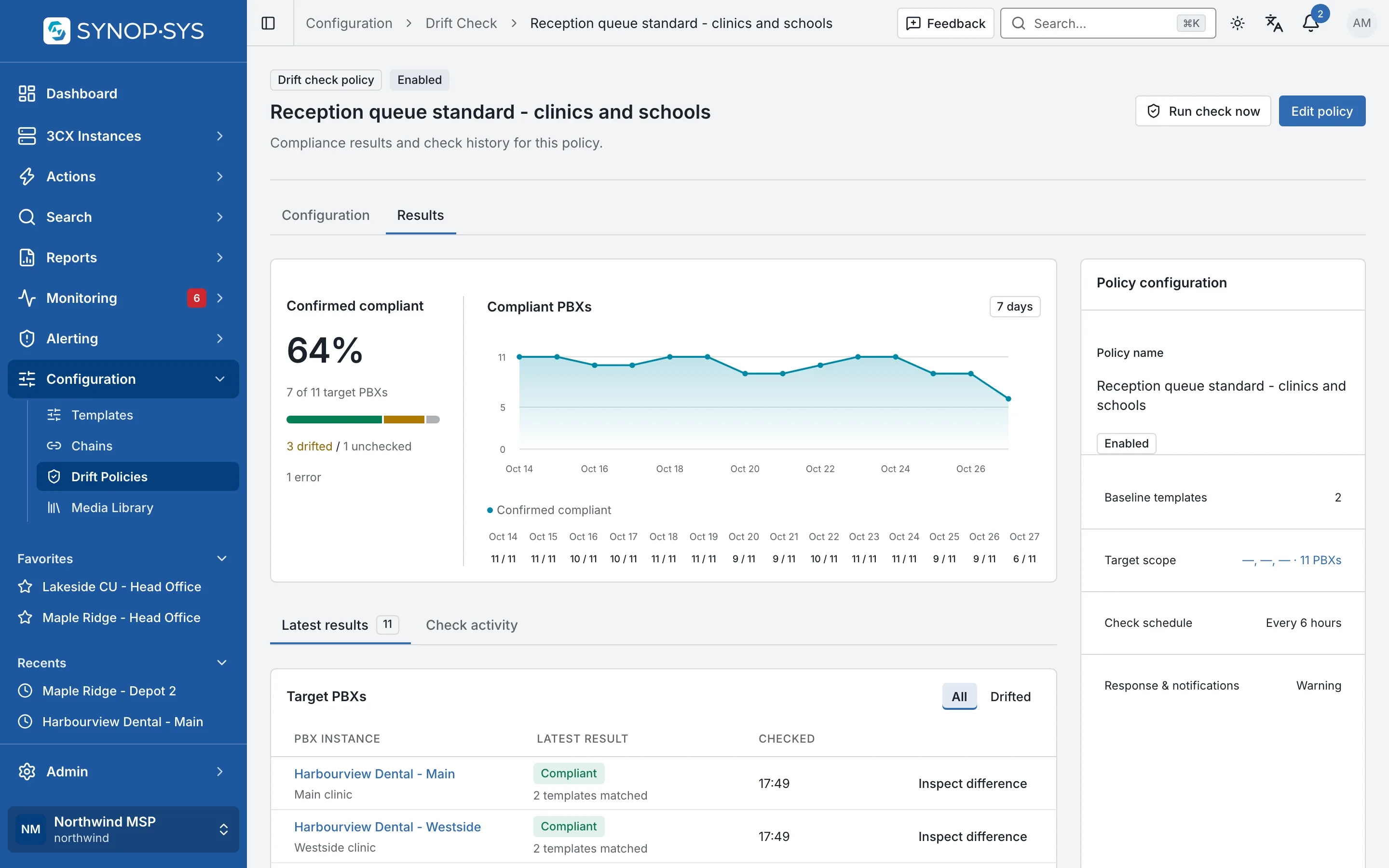
Open a drift result to compare expected and observed values. Results distinguish established compliance from drift, errors and targets whose state could not be determined.

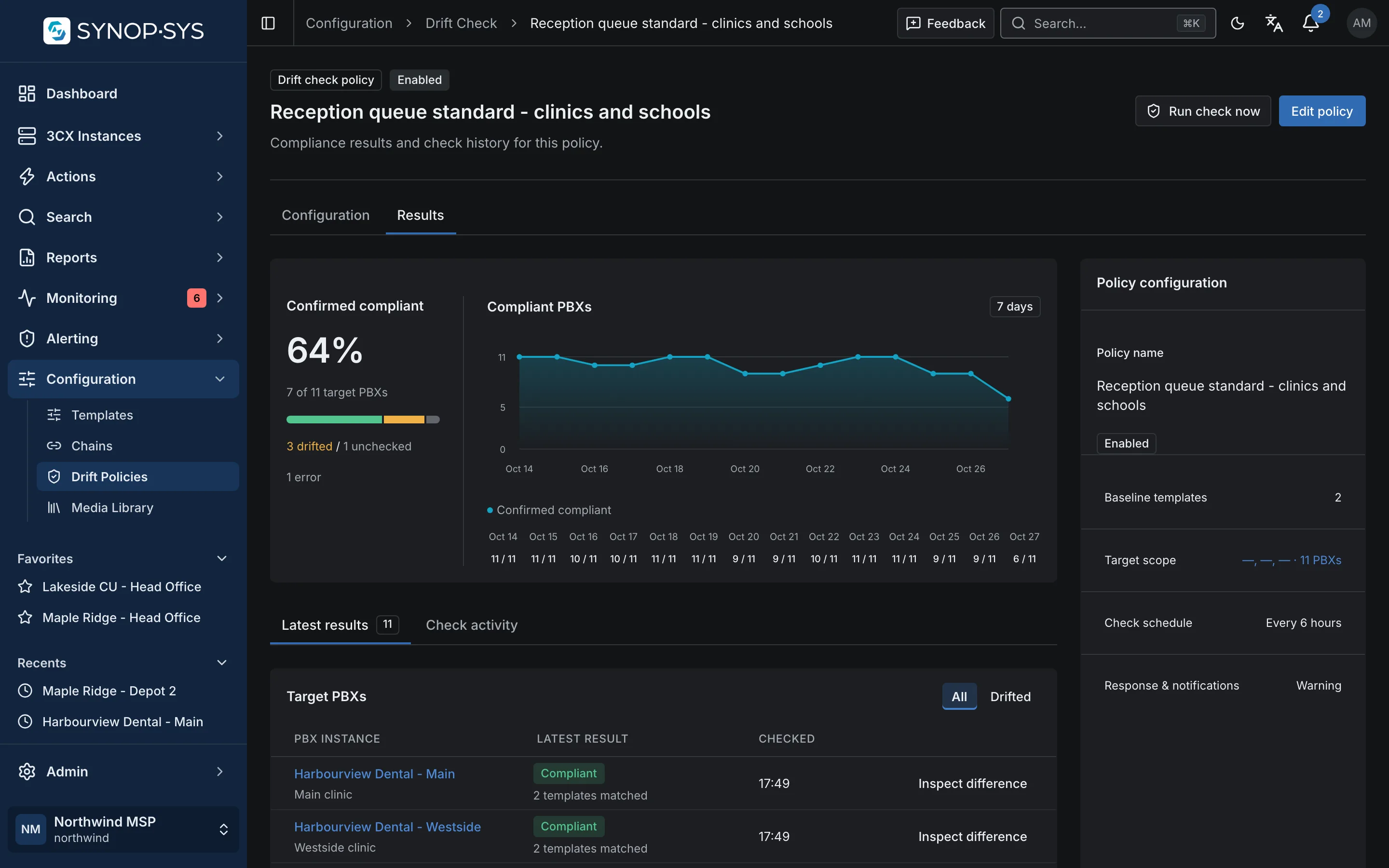
Fourteen days of compliance for the policy’s eleven targets and the policy summary. Fourteen days of compliance for the policy’s eleven targets and the policy summary.
Fourteen days of compliance for the policy’s eleven targets and the policy summary.Open full imageOpen full image
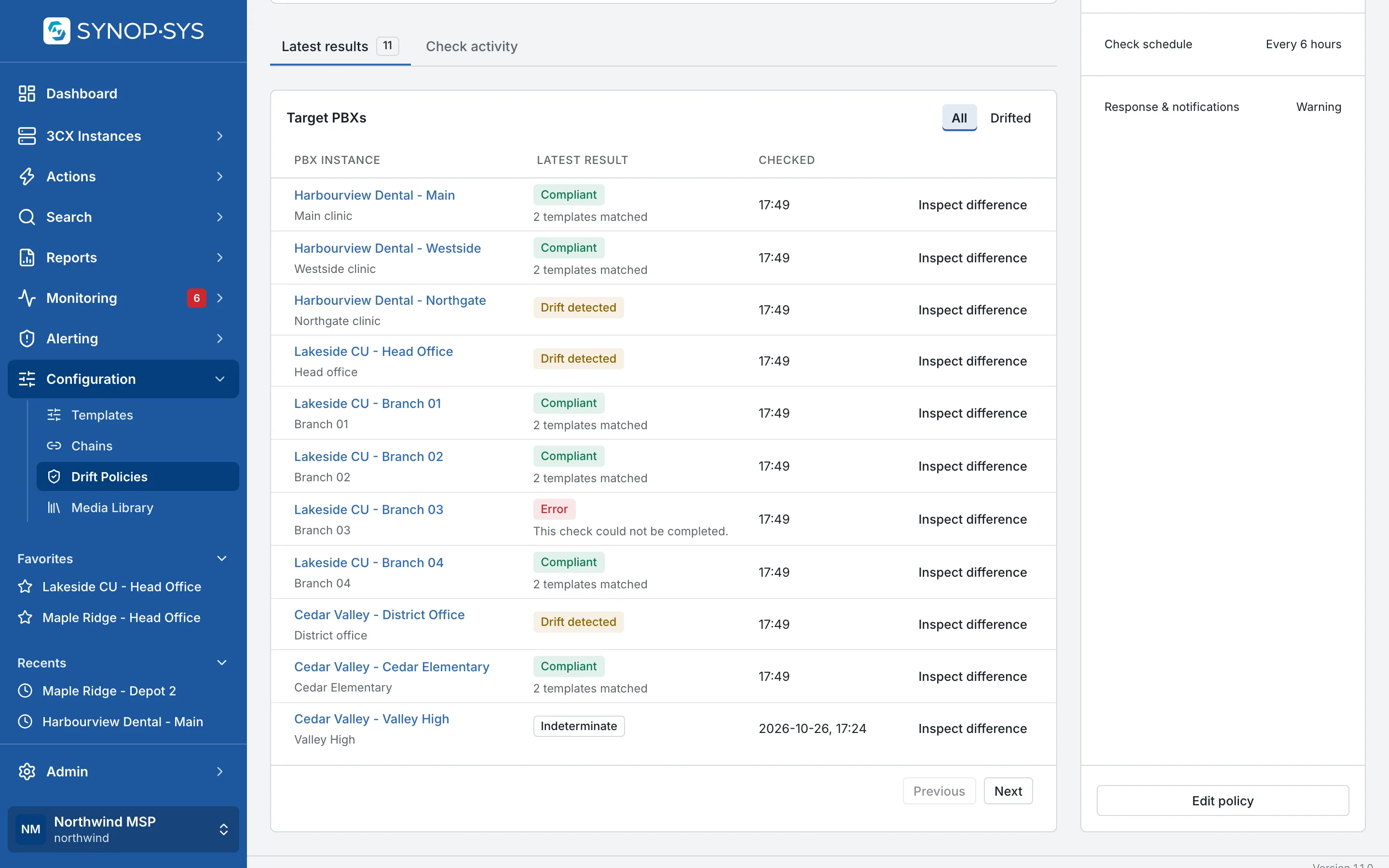
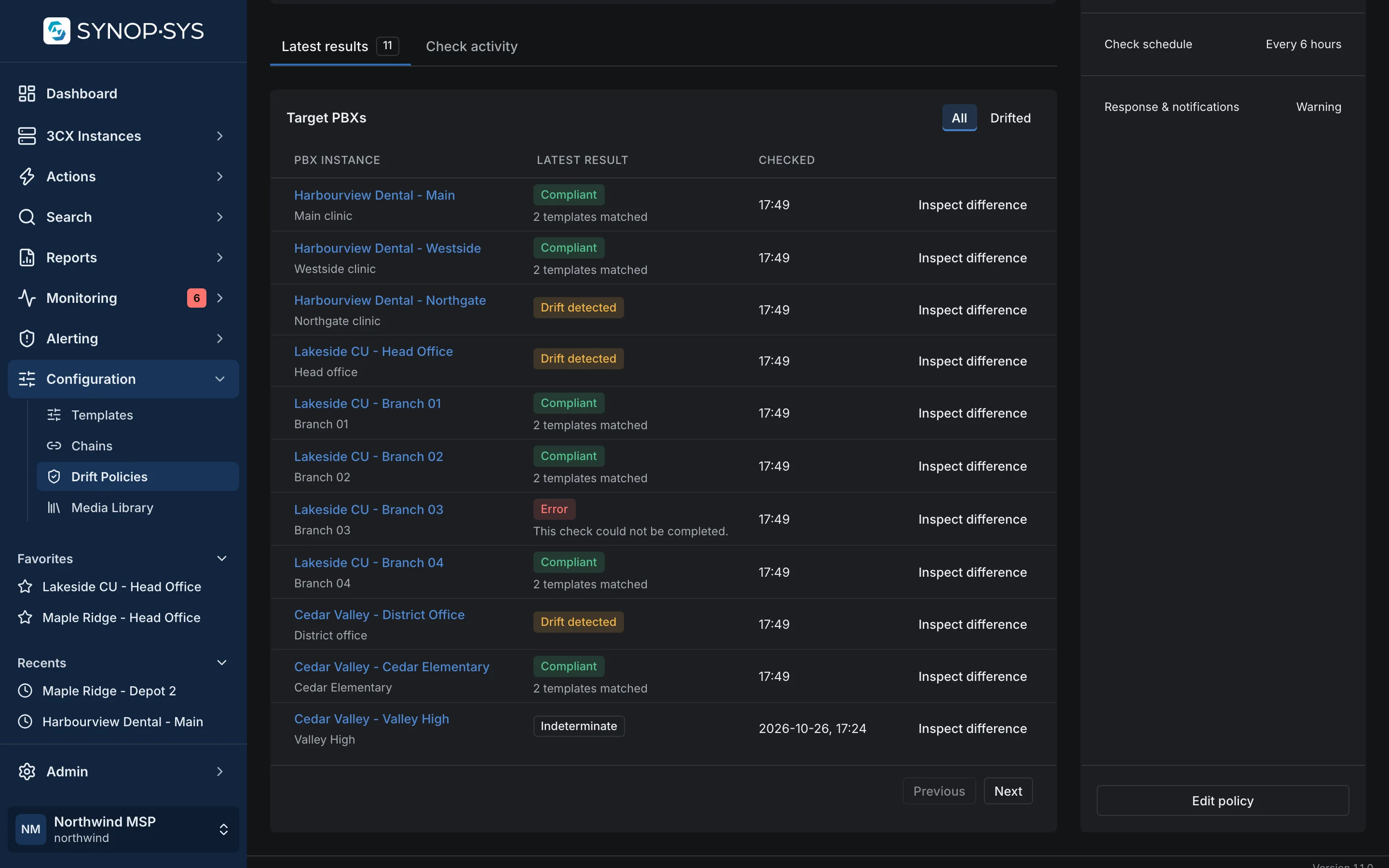
Latest results: compliant, drifted, one error and one indeterminate check, each with its checked time. Latest results: compliant, drifted, one error and one indeterminate check, each with its checked time.
Latest results: compliant, drifted, one error and one indeterminate check, each with its checked time.Open full imageOpen full image

Decide How the Policy Responds

Configure detection, alert generation and optional auto-remediation for the policy. Auto-remediation changes live configuration, so it is an explicit setting, off by default.

  • Drift checks only the fields the template manages
  • An error or an unreachable PBX is never counted as compliant
  • Saved schedules do not retain secret template variables

Read the drift guide (sign-in required)

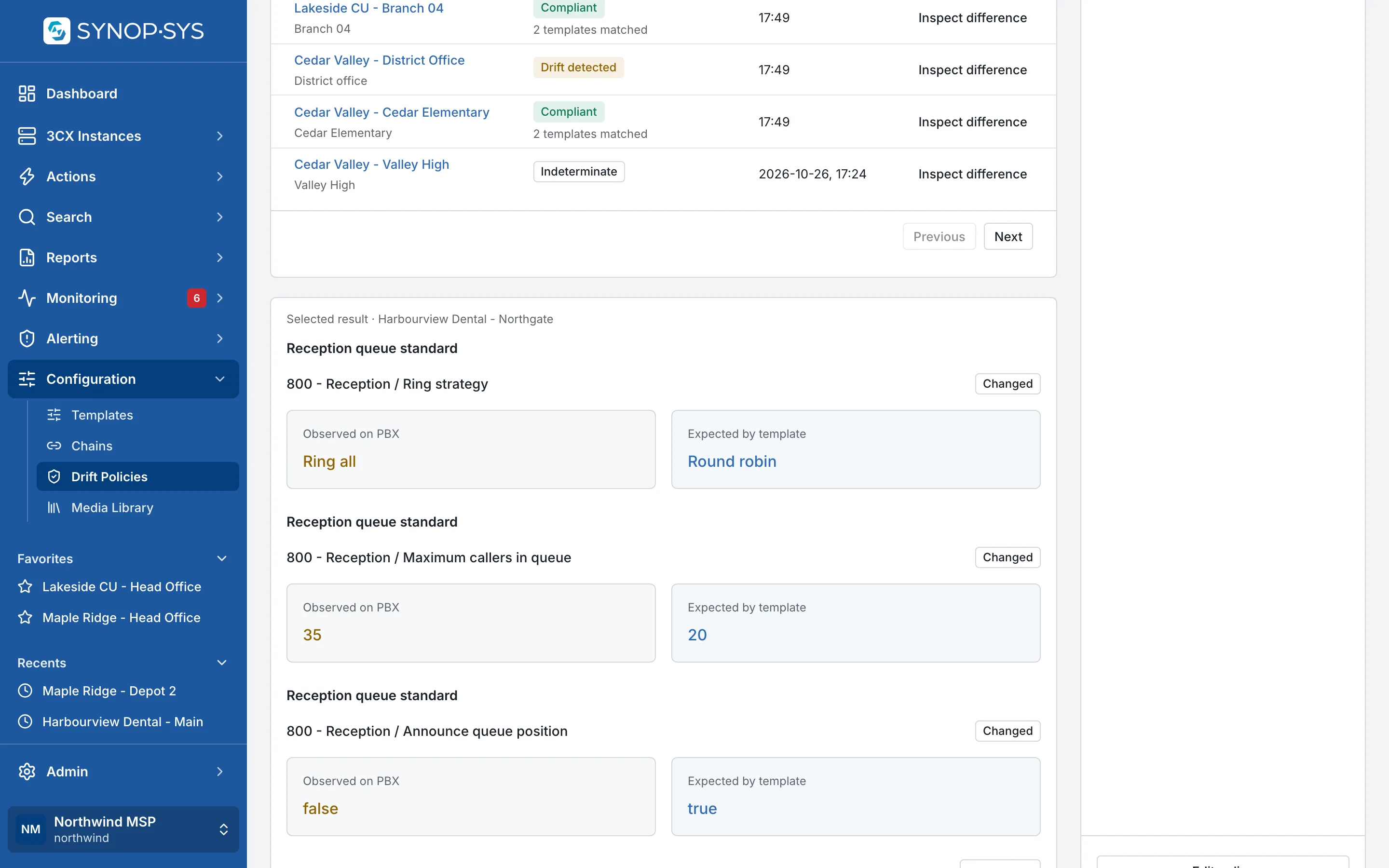
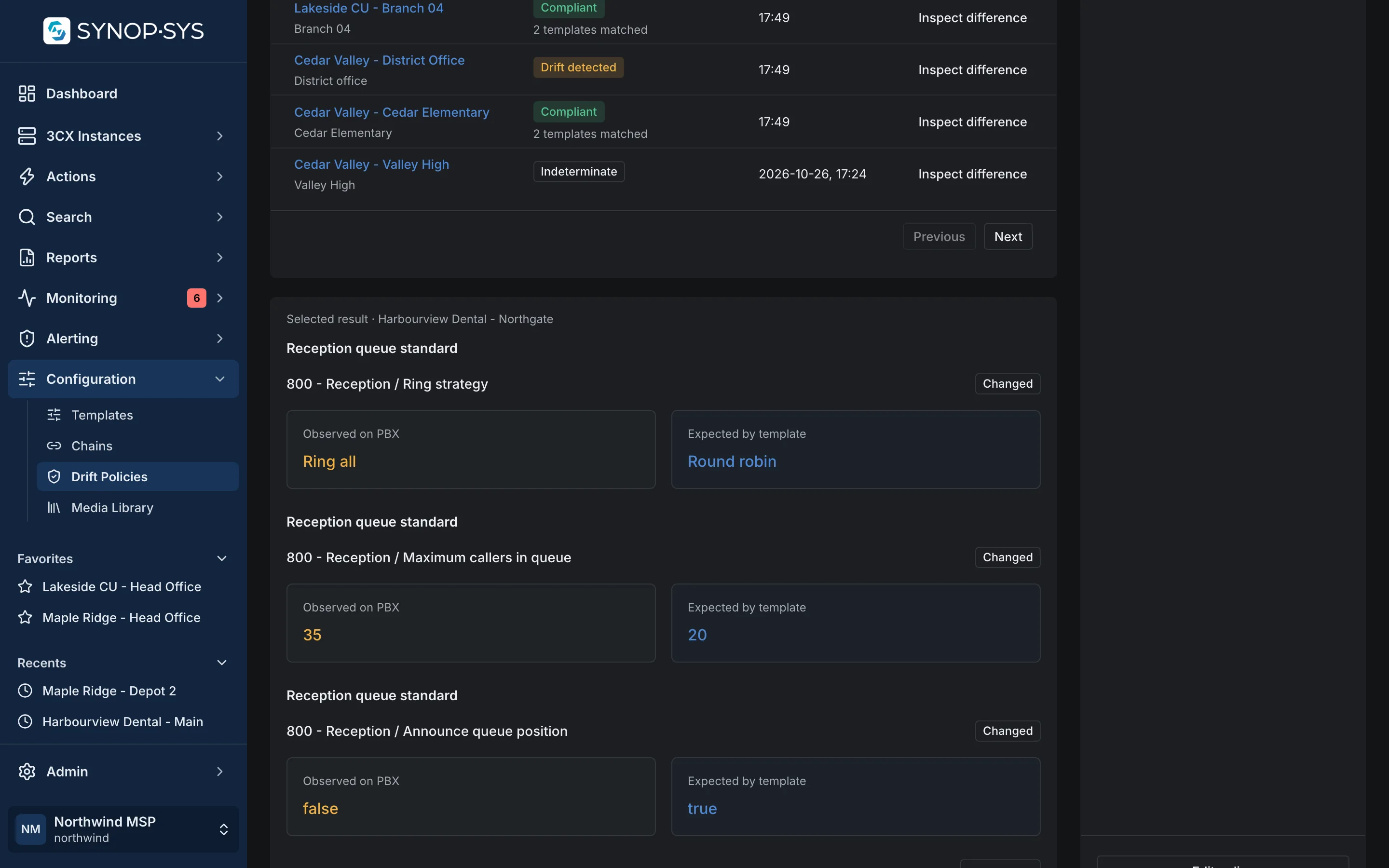
Inspect difference on a drifted PBX: expected and observed values for three managed fields. Inspect difference on a drifted PBX: expected and observed values for three managed fields.
Inspect difference on a drifted PBX: expected and observed values for three managed fields.Open full imageOpen full image

What Is Your Standard Today?

Bring one queue, one outbound rule or one backup setting; we will show how it becomes a template and a drift policy.